
Nearly 80 percent of leading businesses credit artificial intelligence with reshaping their digital marketing strategies. As technology advances, the pressure to deliver smarter campaigns and personalized experiences grows stronger for every marketer. Understanding how AI powers this shift is crucial for anyone aiming to gain a competitive edge, since the right tools can turn raw data into targeted, measurable results that drive real growth.
Key Takeaways
| Point | Details |
|---|---|
| AI Revolutionizes Marketing | AI enables businesses to personalize marketing efforts through data-driven strategies, enhancing customer engagement and optimizing campaigns. |
| Diverse AI Solutions Available | Key AI marketing tools include predictive analytics, personalization engines, and chatbots, all aimed at improving efficiency and customer experiences. |
| Ethical Considerations Are Crucial | Businesses must address data privacy and algorithmic bias when implementing AI, ensuring responsible use and maintaining consumer trust. |
| Strategic Integration Is Key | Successful adoption of AI requires balancing technology with human oversight to enhance creativity and optimize marketing operations. |
Defining AI In Digital Marketing Today
Artificial Intelligence (AI) in digital marketing represents a transformative technological shift that allows businesses to leverage intelligent algorithms and machine learning to understand, predict, and engage customers with unprecedented precision. By integrating advanced computational techniques, AI enables marketing professionals to move beyond traditional one-size-fits-all strategies toward highly personalized, data-driven approaches.
At its core, AI in digital marketing functions through sophisticated machine learning algorithms that analyze massive datasets to extract actionable consumer insights. These algorithms can process complex behavioral patterns, demographic information, and engagement metrics far more quickly and accurately than human analysts. For instance, AI systems can instantly evaluate thousands of customer interactions to determine optimal messaging, timing, and channel selection for marketing campaigns.
Key capabilities of AI in digital marketing include:
- Predictive Analytics: Forecasting customer behaviors and preferences
- Personalization Engines: Generating tailored content and recommendations
- Automated Customer Segmentation: Clustering audiences based on nuanced characteristics
- Real-time Performance Optimization: Dynamically adjusting marketing strategies
The impact of AI extends across multiple marketing domains. Explore our guide on essential digital marketing strategies to understand how these intelligent technologies are reshaping customer engagement. By combining machine learning with strategic human oversight, businesses can create more responsive, intelligent marketing ecosystems that adapt in real-time to changing consumer landscapes.

Major Types Of AI Marketing Solutions
The landscape of AI marketing solutions is rapidly evolving, offering businesses powerful tools to transform their digital strategies through intelligent, data-driven technologies. Machine learning algorithms and advanced computational models have created a diverse ecosystem of AI solutions that can dramatically enhance marketing performance across multiple domains.
Key types of AI marketing solutions include:
-
Predictive Analytics Platforms: These sophisticated systems leverage historical data and machine learning to forecast customer behaviors, predict market trends, and optimize marketing resource allocation. They can anticipate customer needs before traditional methods even recognize emerging patterns.
-
Personalization Engines: Advanced AI technologies that create hyper-targeted content and recommendations by analyzing individual user interactions, browsing history, and engagement metrics in real-time.
-
Chatbots and Conversational AI: Intelligent communication systems that provide instant customer support, qualify leads, and guide users through complex sales processes with human-like interaction capabilities.
-
Content Generation AI: Algorithmic tools that can produce marketing copy, social media posts, email campaigns, and creative assets tailored to specific audience segments.
-
Customer Segmentation Algorithms: Powerful AI systems that cluster audiences based on nuanced behavioral characteristics, enabling more precise targeting and messaging strategies.
When implementing these solutions, businesses must balance technological capability with strategic human oversight. Learn how to automate your sales process to understand how AI can seamlessly integrate with existing marketing workflows. The goal is not replacement, but augmentation – using AI to enhance human creativity and strategic thinking while improving operational efficiency.
Key Applications And Real-World Use Cases
Artificial Intelligence is transforming digital marketing through practical, innovative applications that solve complex business challenges. From small local businesses to enterprise-level organizations, AI technologies are creating unprecedented opportunities for more intelligent, responsive, and efficient marketing strategies across multiple industries and sectors.
Customer Experience Optimization represents one of the most powerful real-world applications of AI in marketing. By analyzing vast amounts of behavioral data, AI systems can create hyper-personalized user experiences that adapt in real-time. For example, e-commerce platforms now use AI to:
- Recommend products based on individual browsing and purchase history
- Customize website layouts for specific user preferences
- Predict potential customer churn before it occurs
- Generate personalized email marketing content
- Provide instant, context-aware customer support through intelligent chatbots
In the realm of content marketing, AI is revolutionizing how businesses create, distribute, and optimize their messaging. Advanced language models can now generate marketing copy, social media posts, and even long-form content that matches brand voice and targets specific audience segments with remarkable precision. Research from recent AI frameworks demonstrates the potential for autonomous content creation that goes beyond simple template-based generation.
For businesses looking to implement these cutting-edge technologies, strategic integration is key. Learn how to automate your sales process to understand how AI can seamlessly enhance your existing marketing workflows. The most successful organizations view AI not as a replacement for human creativity, but as a powerful tool to augment and accelerate marketing capabilities, enabling teams to focus on high-value strategic initiatives.
Benefits And Challenges For Businesses
Artificial Intelligence in digital marketing presents a complex landscape of transformative opportunities and strategic challenges that require nuanced understanding. Businesses across industries are discovering that AI is not just a technological upgrade, but a fundamental shift in how marketing strategies are conceptualized, developed, and executed.
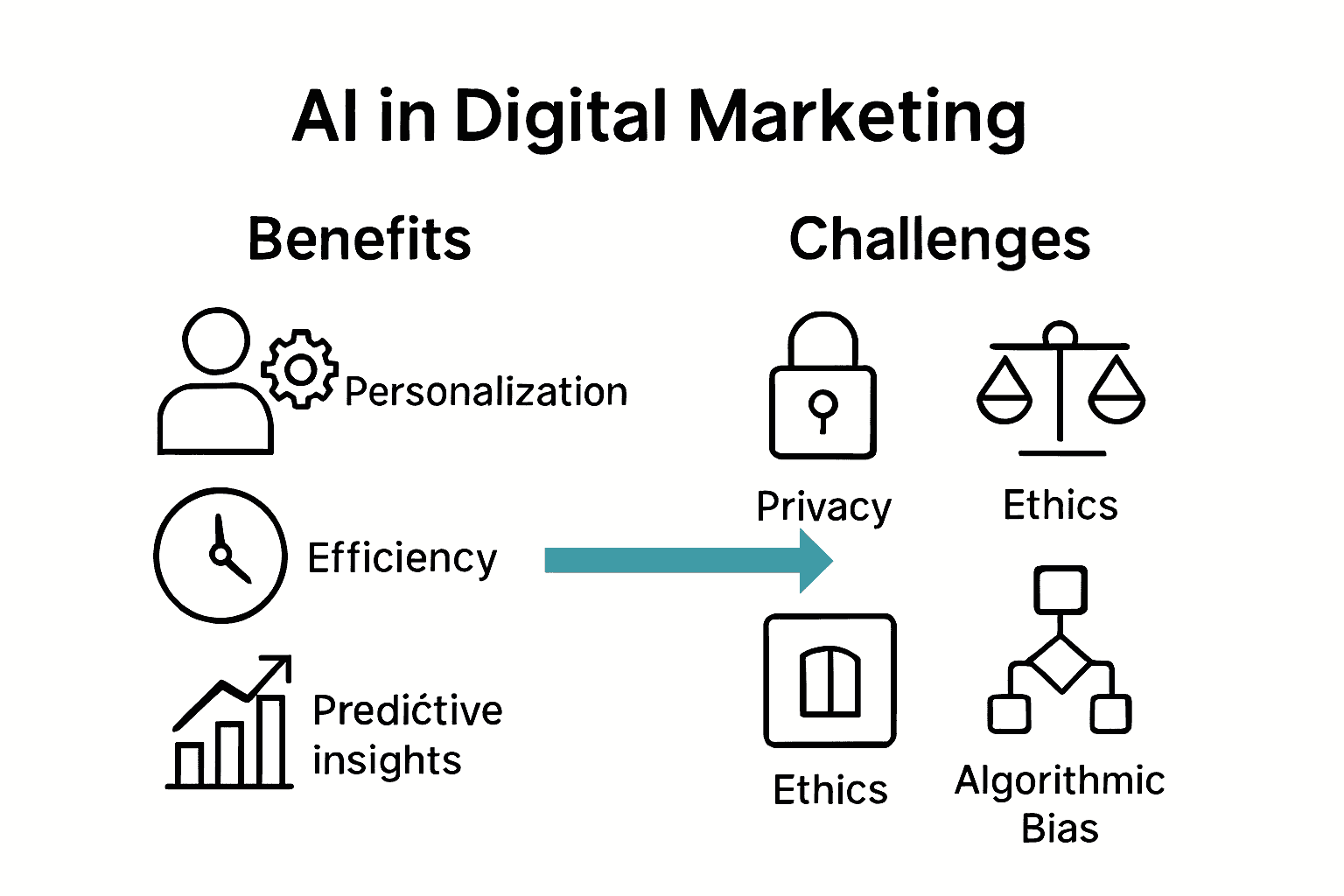
Key Benefits of AI Marketing Solutions include:
- Enhanced Personalization: Creating hyper-targeted experiences that dramatically improve customer engagement
- Operational Efficiency: Automating repetitive tasks and reducing manual marketing workload
- Predictive Insights: Generating accurate forecasts about customer behaviors and market trends
- Cost Reduction: Minimizing resource expenditure through intelligent, data-driven decision-making
- Real-time Optimization: Continuously adjusting marketing strategies based on immediate performance data
However, implementing AI technologies is not without significant challenges. Ethical Considerations and Privacy Concerns remain critical obstacles for businesses. Organizations must navigate complex regulatory landscapes, ensuring data protection, maintaining transparent AI practices, and preventing algorithmic bias. This requires robust governance frameworks and continuous monitoring of AI systems to guarantee responsible and equitable marketing practices.
Explore strategies for automating your sales process to understand how businesses can effectively balance technological innovation with strategic human oversight. The most successful companies will view AI as a collaborative tool that enhances human creativity rather than a complete replacement for marketing expertise.
Risks, Ethics, And Future Implications
Artificial Intelligence in digital marketing represents a powerful technological frontier that demands careful navigation through complex ethical and strategic landscapes. As AI systems become increasingly sophisticated, businesses must proactively address potential risks and develop robust frameworks for responsible technological implementation.
Key Ethical Risks in AI marketing include:
- Data Privacy Violations: Potential unauthorized use or inappropriate collection of personal information
- Algorithmic Bias: Unintentional discrimination through machine learning models
- Transparency Challenges: Lack of clear understanding about how AI makes marketing decisions
- Consumer Consent and Control: Ensuring meaningful user agreement and opt-out mechanisms
- Potential Manipulation: Risk of using AI to exploit psychological vulnerabilities
The future of AI in marketing will likely be defined by a delicate balance between technological innovation and ethical responsibility. Organizations must develop comprehensive governance models that prioritize transparency, accountability, and human-centric design. This involves creating interdisciplinary teams that include not just technologists, but also ethicists, legal experts, and consumer advocates who can provide nuanced oversight.
Learn strategies for automating your sales process to understand how businesses can implement AI technologies with integrity and strategic vision. The most forward-thinking companies will view ethical AI not as a constraint, but as a competitive advantage that builds long-term trust and demonstrates genuine commitment to responsible innovation.
Unlock the Full Potential of AI in Your Digital Marketing Strategy
If you are navigating the complex challenge of integrating AI technologies into your marketing efforts you already understand the power of predictive analytics personalization engines and automated customer engagement. This expert guide highlights how AI can transform your approach but implementing these advanced solutions requires the perfect blend of strategic insight and cutting-edge tools.
At Fleek Consulting we help companies of all sizes overcome these hurdles through our proven AI-powered systems. From boosting your local presence with GeoAmp to enhancing organic search visibility with FleekFlow AI our services are designed to deliver measurable growth using intelligent automation. Explore actionable strategies and drive real results by visiting our Digital Marketing Strategy – Fleek Consulting and learn how to create personalized, efficient marketing workflows.
Don’t let your business fall behind in this evolving landscape Engage our expert team today at Fleek Consulting and discover how AI-driven marketing can elevate your brand. Take control now with advanced Lead Nurturing Automation – Fleek Consulting that enhances engagement and accelerates your sales pipeline.
Frequently Asked Questions
What is AI in digital marketing?
AI in digital marketing refers to the use of artificial intelligence technologies such as machine learning algorithms to analyze data, understand consumer behavior, and optimize marketing strategies for more personalized engagement.
How does AI enhance customer experience in marketing?
AI enhances customer experiences by analyzing vast amounts of behavioral data to create hyper-personalized interactions. This includes product recommendations, customized content, and real-time support through tools like chatbots.
What are the main benefits of using AI marketing solutions?
The main benefits of AI marketing solutions include enhanced personalization, operational efficiency, predictive insights, cost reduction, and real-time optimization of marketing strategies based on data-driven insights.
What challenges do businesses face when implementing AI in marketing?
Businesses face challenges such as ethical considerations, data privacy concerns, algorithmic bias, transparency issues, and the need for robust governance frameworks to ensure responsible AI implementation.
Recommended
- The Essential Guide to Why Digital Marketing Matters – Fleek Consulting
- 7 Essential Types of Digital Marketing for Business Growth – Fleek Consulting
- 7 Local Marketing Best Practices for Sustainable Growth – Fleek Consulting
- Complete Guide to Search Engine Algorithms – Fleek Consulting
- IA Inteligencia Artificial: Guía Completa y Aplicaciones – Aithor
- En Qué Áreas Se Utiliza la Inteligencia Artificial – Aithor